
Crash Ratings for Bollards
Q: What are the crash ratings for bollards?
A: Crash ratings are used to measure the performance and strength of vehicle security barriers, including bollards, during a controlled impact test. These ratings help determine how effectively a barrier can stop or slow down a vehicle attempting to breach a protected area.
Modern vehicle barrier testing is commonly evaluated using the ASTM F2656 standard, which provides a consistent method for measuring the impact performance of security barriers. This standard has become the widely recognized benchmark for evaluating vehicle crash resistance and has replaced older testing classifications previously used by organizations such as the Department of Defense (DoD).
3 Key Factors That Determine a Bollard Crash Rating
1. Vehicle Weight
The size and weight of the impact vehicle play a major role in determining barrier performance. Heavier vehicles generate greater impact forces and require stronger security solutions to stop effectively.
2. Vehicle Speed
Impact speed directly affects the amount of energy transferred during a crash. Higher-speed impacts require barriers engineered to absorb and withstand increased forces.
3. Vehicle Penetration Distance
Crash ratings also consider how far the vehicle continues beyond the barrier after impact. A lower penetration distance indicates stronger stopping performance and improved protection.
Barrier Stop provides a range of bollards and vehicle security solutions engineered around recognized crash-testing standards to help protect facilities, people, and critical infrastructure from vehicle threats.
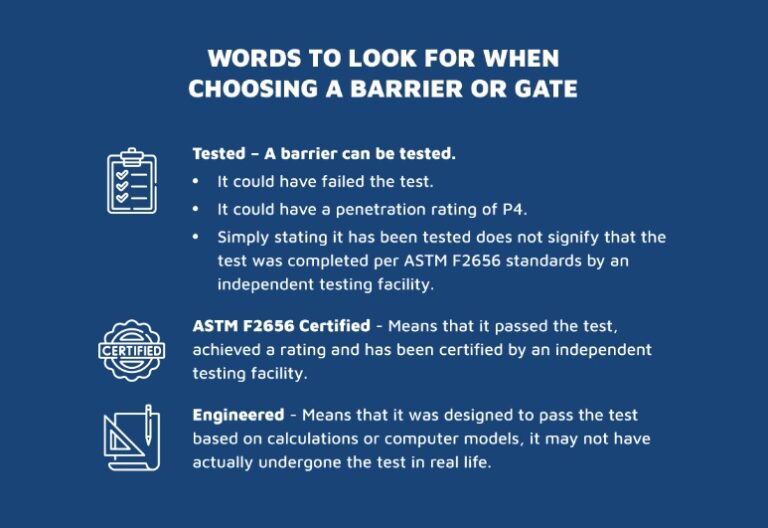
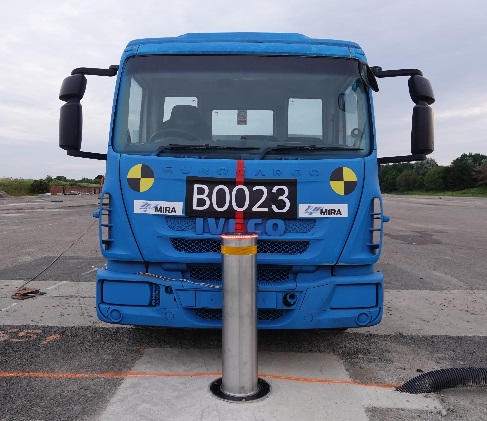
Understanding Crash RatiStopngs with Barrier
Understanding Crash Rating with Barrier Stop
Crash ratings help evaluate the strength and effectiveness of vehicle security barriers by measuring how well they perform during controlled impact testing. Barrier Stop uses these performance standards to help customers select the right protection level for their specific security needs, whether for commercial, government, industrial, or high-security applications.
What Do These Ratings Mean?
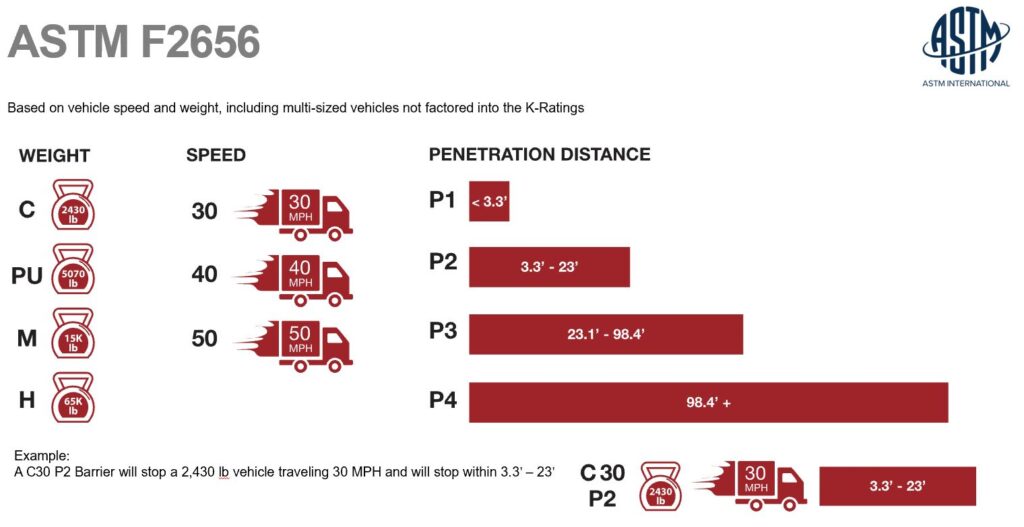
ASTM vehicle crash ratings evaluate the performance of security barriers based on key impact factors, including:
- Vehicle Weight – The mass of the vehicle used during the impact test.
- Vehicle Speed – The speed at which the vehicle strikes the barrier.
Another important measurement is the P-rating (Penetration Rating). This rating indicates how far a vehicle travels beyond the barrier after impact. A shorter penetration distance represents stronger stopping performance and improved vehicle control.
The 3 Penetration Ratings
Barrier Stop uses recognized penetration classifications to help demonstrate the performance level of its vehicle security barriers:
P-1 (Highest Protection Level)
The vehicle comes to a stop within 3.3 feet (1 meter) beyond the barrier after impact. This represents the highest level of penetration control and stopping capability.
P-2 (Enhanced Protection)
The vehicle continues between 3.3 feet and 23 feet (1–7 meters) after impact. This rating provides strong vehicle mitigation performance for many security applications.
P-3 (Standard Protection Level)
The vehicle travels approximately 23.1 feet to 98.4 feet (7.1–30 meters) beyond the barrier following impact. This provides a lower level of penetration control compared to P-1 and P-2 classifications.
When selecting a Barrier Stop vehicle barrier, understanding the penetration rating helps determine the right level of protection for your facility, traffic conditions, and security requirements. Products with a P-1 rating provide the most limited vehicle penetration and the highest level of impact control.
From K-Ratings to M-Ratings
Older Department of Defense (DoD) K-ratings were widely used beginning in 1985 to classify vehicle barrier performance. These classifications have since been replaced by the updated M-ratings, which provide more detailed information about vehicle type, impact speed, vehicle weight, and penetration results for a more complete evaluation of barrier performance.
M-RATINGS: NEW METHOD
The M-Rating system is the modern method used to evaluate vehicle barrier performance and provides a more detailed assessment than the older K-Rating classifications. It considers a broader range of factors, including vehicle type, vehicle weight, impact speed, and penetration distance after impact.
Based on ASTM F2656 vehicle crash testing standards, M-Ratings measure how effectively a barrier stops a vehicle by evaluating how far the vehicle’s payload travels beyond the barrier after impact. This provides a more accurate understanding of a barrier’s real-world stopping performance.
Like the previous K-Rating system, M-Ratings are categorized by vehicle size, impact speed, and penetration results. Penetration performance is classified into four levels:
ASTM Penetration Classifications
P1 Rating
The vehicle travels up to 3.3 feet (1 meter) beyond the barrier after impact. This represents the highest level of stopping control.
P2 Rating
The vehicle travels between 3.31 feet and 23 feet (1–7 meters) beyond the barrier.
P3 Rating
The vehicle travels between 23.1 feet and 98.4 feet (7.1–30 meters) beyond the barrier.
P4 Rating
The vehicle travels more than 98.4 feet (30 meters) beyond the barrier.
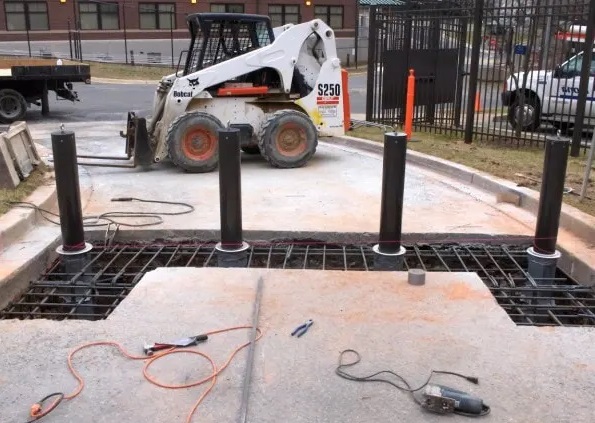
Examples of ASTM Vehicle Crash Ratings
| Vehicle Category | Maximum Vehicle Weight | Available Impact Classifications |
|---|---|---|
| Small Car (SC) | 2,430 lbs. / 1,102 Kg | SC30, SC40, SC50, SC60 |
| Full Size Sedan (FS) | 4,630 lbs. / 2,100 Kg | FS30, FS40, FS50, FS60 |
| Pickup Truck (PU) | 5,070 lbs. / 2,300 Kg | PU30, PU40, PU50, PU60 |
| Medium Goods Vehicle (M) | 15,000 lbs. / 6,800 Kg | M30, M40, M50 |
| Heavy Goods Vehicle (H) | 65,000 lbs. / 26,500 Kg | H30, H40, H50 |
ASTM Penetration Levels
| Rating | Vehicle Penetration Distance |
|---|---|
| P1 | Up to 3.3 feet (1 meter) |
| P2 | Up to 23 feet (7 meters) |
| P3 | Up to 98 feet (30 meters) |
| P4 | Greater than 98 feet (30 meters) |
Understanding M-Ratings allows facility owners, security professionals, and engineers to select the appropriate vehicle barrier based on the required level of protection, site conditions, and potential vehicle threats.